
A Glorious Sacrifice

And beginning with Moses and all the Prophets, he explained to them what was said in all the Scriptures concerning himself.
Luke 24: 27
As Jesus walked along the road with Cleopas and his companion, he began with Moses and all the Prophets, and explained to them what was said in all the Scriptures concerning himself. Today, I want to explore the Old Testament prophecies that foretold Jesus’ sacrificial death. The sacrificial death of Jesus is central to the Gospel, and even more fascinating is that the Bible reveals, even before Jesus lived, that he would not only die but that his death would be sacrificial.
I want to be clear: I want to look at Jesus’ sacrificial death in the Old Testament, not just the prophecies showing that he would die. There are several prophecies concerning Jesus’ death and the manner of his death.
I could easily point to Ps 22 and find detailed descriptions of Jesus on the cross: “My God, my God, why have you forsaken me” (Ps 22:1), “All who see me mock me; they hurl insults, shaking their heads. “He trusts in the Lord,” they say, “let the Lord rescue him. Let him deliver him, since he delights in him.” (Ps 22:7–8, NIV) “My mouth is dried up like a potsherd, and my tongue sticks to the roof of my mouth; you lay me in the dust of death.” (Ps 22:15, NIV) “Dogs surround me, a pack of villains encircles me; they pierce my hands and my feet.” (Ps 22:16, NIV) “They divide my clothes among them and cast lots for my garment.” (Ps 22: 18, NIV) But these prophecies lack one vital component: none of them points to a sacrificial death. The details in the prophecies are amazing, but I don’t want to look at them today. David was king, but God used him mightily as a prophet. But today, I want to concentrate on the sacrificial death of Jesus.
And so, I want to focus on two scriptures, both from the prophet Isaiah. He wrote in chapter 53, the following: “But he was pierced for our transgressions, he was crushed for our iniquities; the punishment that brought us peace was on him, and by his wounds we are healed. We all, like sheep, have gone astray, each of us has turned to our own way; and the Lord has laid on him the iniquity of us all.” (Isa 53: 4 to 6, NIV) and the second is, “Therefore I will give him a portion among the great, and he will divide the spoils with the strong, because he poured out his life unto death, and was numbered with the transgressors. For he bore the sin of many, and made intercession for the transgressors.” (Isa 53: 12, NIV)
Jesus went to the cross, and his hands and feet were pierced by the nails that held him there. I say “held”, but of course Jesus said to Peter when he cut off the servant’s ear, “Do you think I cannot call on my Father, and he will at once put at my disposal more than twelve legions of angels? But how then would the Scriptures be fulfilled that say it must happen in this way?” Jesus could have come down from the cross at any moment he chose, but the most important thing to him was to do His Father’s will; to go to the cross, die, and then rise three days later.
We are all sinners, as Paul put it, “for all have sinned and fall short of the glory of God”, and the consequence of that is that we deserve the due punishment – death. And as we all know, we will all die at some point. This is physical death. But there is more than physical death; there is spiritual death.
At the very beginning, when there were only Adam, Eve, and God, they enjoyed perfect harmony and walked together in the Garden. But tragically, Adam and Eve chose to go their own way rather than follow God’s way. They ate the fruit they had been clearly told not to eat. They disobeyed God, and physical death entered the world. Both Adam and Eve died, and their children also died, and from then on, everyone who has been born has died. Back in the Garden of Eden, after they ate the fruit, God cast them out of the Garden and His presence. They died spiritually.
The beautiful thing about Jesus’ sacrifice was that he died on the cross for us. He died in our place. He died for the sins we committed and will commit. He who was sinless became sinful so that we who are sinful can become sinless. Isaiah wrote, “Though your sins are like scarlet, they shall be as white as snow; though they are red as crimson, they shall be like wool.” God sees us as sinless, spotless, and without blemish. When the trumpet sounds at the second coming of God, we are all called to give an account of ourselves. He will look at us and see that we have washed our robes and made them white in the blood of the sacrificial Lamb. He will welcome us into His presence.
When Adam and Eve were cast out of God’s presence, they lost the peace that had existed between God and mankind. Now, with Jesus’ death and resurrection, that peace can be restored. We only have to look at the sacrifice Jesus made on the cross, admit that He did it for our sins, and, by faith, we can be made right with God.
God can look beyond our sins and declare us justified – just as if I hadn’t sinned – and we now have peace with God. As Paul put it nicely, “since we have been justified through faith, we have peace with God through our Lord Jesus Christ, through whom we have gained access by faith into this grace in which we now stand.”
In many cases, the Hebrew word rapha, from which we get the word heal, is used in the context of physical healing. God heals physically, and we see this throughout the gospels; wherever Jesus went, he healed someone.
However, the word “raphe” is used in this verse to mean something else. It is spiritual healing, not physical healing. If we look at 1 Peter 2, then we read, “He personally carried our sins in his body on the cross so that we can be dead to sin and alive for what is right. By his wounds you are healed.” You see, there is no mention of physical healing; it’s all about our relationship with God. We have already seen God heal physically in previous verses, but here we see spiritual healing.
The prophet Isaiah said that God would give the suffering servant a portion among the great, and the suffering servant would divide the spoils with the strong. We can see this in the life of Jesus Christ.
The Good News Version says: “And so I will give him a place of honour, a place among the great and powerful.” And the New Living Translation says: “I will give him the honours of a victorious soldier.” These are quite distinctive but show the mind of God in this passage.
We also need to remind ourselves of where we are in Jesus Christ’s timeline. In verse 11 we read, “After he has suffered, he will see the light of life and be satisfied.” Jesus, the Suffering Servant, has now become the risen Saviour, and so we need to look at this verse in this context – Jesus Christ has now ascended.
The Bible records that when Jesus Christ ascended, he returned to be with God the Father. On earth, God turned his back on the man Jesus because he had become sin, but now the ascended Jesus again became the sinless Son of God who had created the world. And so, in the presence of Father God, Jesus Christ, the Son of God, sat down. And there he received the praise and worship from those in heaven.
The Book of Revelation pictures Jesus Christ as a slain lamb sitting on the throne. “The twenty-four elders fell down before the Lamb. Each had a harp, and they held golden bowls full of incense, which are the prayers of God’s people. And they sang a new song, saying: ‘You are worthy to take the scroll and to open its seals because you were slain, and with your blood, you purchased for God persons from every tribe and language and people and nation. You have made them to be a kingdom and priests to serve our God, and they will reign on the earth.’ Jesus Christ sat on the throne in heaven, and he received a place of honour, a place among the great and powerful Almighty God. He received honour and praise as he was victorious over sin and death. When he was on earth, Jesus fought “against the rulers, against the authorities, against the powers of this dark world and against the spiritual forces of evil in the heavenly realms” and overcame them.
Let me finish with this quote from the Book of Revelation. “Then I looked and heard the voice of many angels, numbering thousands upon thousands, and ten thousand times ten thousand. They encircled the throne and the living creatures and the elders. In a loud voice, they were saying: ‘Worthy is the Lamb, who was slain, to receive power and wealth and wisdom and strength and honour and glory and praise!’ (Rev 5: 11&12, NIV)
Yes, Jesus received all the honour that He deserves because He was the one who was victorious over sin and death. He is the one who brought us peace with God the Father, and He is the one who has washed us clean.
============================================================================
Audible Book
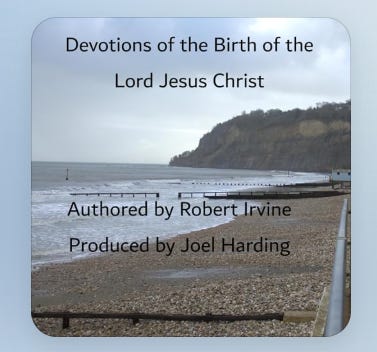
As many of you know, I have published a book entitled “Devotions on the Birth of the Lord Jesus Christ”. This Kindle book can be bought on Amazon.
However, the Audible version of the book is now available on Audible, Amazon and iTunes.
Happy reading or happy listening!
Bravo Rev Robert!