
2026 Easter Message

It’s Easter Sunday, the day we remember the glorious event when Jesus rose from the dead. Every time we take communion, or the Eucharist, we “proclaim the Lord’s death until he comes.” Yes, within these seven words is an implicit fact that for Jesus Christ to come back a second time, he must have risen from the dead to be able to return. But today we explicitly recall the resurrection, and I want to explore the events that followed.
First, we recall that Mary Magdalene went to the tomb and found it empty. She returned to the disciples to tell them that Jesus’ body was gone. Peter and John ran to the tomb and saw the empty tomb and, “... saw the strips of linen lying there, as well as the cloth that had been wrapped around Jesus’ head. The cloth was still lying in its place, separate from the linen.”
But when Peter and John returned to their accommodation, they left Mary in tears. It was the risen Jesus who softly reassured her by calling her by her name, “Mary.” The distraught woman became jubilant as she rushed back to the disciples to proclaim to them, “I have seen the Lord!” and that he said, “‘I am ascending to my Father and your Father, to my God and your God.’”
You might not have noticed, and I certainly didn’t, but the grave clothes were left in an orderly fashion. “The cloth was still lying in its place, separate from the linen.” The face cloth was separate from the linen. This was an orderly event.
If we look at the Creation story, it was also an orderly event. Each item was created at its proper place and time. First, there was light. Then the sky was formed. Next, we saw the land, the seas, and the oceans. Fourth, there were the stars in the sky. Fifth were the fish in the seas and the birds of the air. Next came the animals and the livestock. Lastly, God created mankind. He created Adam and Eve. The world and the universe were orderly, with everything in its proper place. When God took a step back, He looked at what He had created, and “God saw all that he had made, and it was very good.” God looks at you and me and thinks we are good
The face cloth or napkin was always laid on the face. There was an order to it, even at a funeral. But now, look around us today; what do we see? We see chaos! We see disorder. We see the result of mankind not following God. We see a chaotic world because people are living sinful lives.
The world is only looking after itself and certainly not after each other. We see fighting: Russia against Ukraine, and the war against the Iranian regime. The Last couple of years, we saw Iran funding the Palestinians, Hamas, Hezbollah and the Houthis against the Israelis. There are civil wars in Sudan, Myanmar, Yemen, and Syria. Islamist terrorist attacks have occurred in various regions around the globe, including the Middle East, North Africa, South Asia, and Sub-Saharan Africa. Jesus’ resurrection was ordlerly but our world is in total chaos.
How often do we hear of drug addicts or drunks getting their chaotic lives pulled together when they come face to face with God? God transforms them and sets their lives back on the straight and narrow. There are many testimonies of drunks and addicts being changed, being transformed because they became Christians.
Just look at the Bible and see how many lives were transformed when they encountered God. Moses was a murderer and a fugitive, but became the leader of the Hebrews and took them out of slavery. Zacchaeus was a tax collector whom the people despised, but he repented after meeting Jesus. Zacchaeus stood up and said to the Lord, “Look, Lord! Here and now I give half of my possessions to the poor, and if I have cheated anybody out of anything, I will pay back four times the amount.”
Saul of Tarsus, who later became known as Paul, persecuted the early Christian church and then became a key figure in spreading the Gospel. Mary Magdalene was a woman known for her past sins, but became a devoted follower of Jesus.
Do you know anyone who needs the power of the cross to transform their lives? Let us pray that our dear friends will come to the foot of the cross and give their lives to Jesus.
The next thing we notice in this passage is that Jesus called the woman by her name, “Mary.” Jesus was concerned because Mary was distressed and, full of compassion, quietly spoke her name. Instantly, she knew it was her Lord, her teacher. She ran to the rest of the disciples full of joy.
Jesus knew her; he understood her completely, including all her faults and vices. Yet, Jesus approached her to reassure her that everything would be okay. He had triumphed over death. Everyone treated her like the scum of the earth because of her past, but Jesus did not. She was freed by Jesus from the seven demons that possessed her. Now, the risen Jesus would grant her victory over Satan and his demons.
On the Day of Pentecost, the Holy Spirit descended upon the one hundred and twenty disciples, and she was among them. On that day, when the disciples spoke in foreign languages to those visiting Jerusalem, she would be included among them.
Peter Simon Peter, who bumbled through life and made mistake after mistake, was transformed by the Holy Spirit on the Day of Pentecost. He became a confident, outspoken apostle who stood up to the Sanhedrin, which had just crucified the Lord Jesus Christ.
Mary Magdalene was transformed before the Day of Pentecost. In response, what did she do? She followed Jesus; where He went, she went. She supported Jesus and the disciples financially and was present at the cross at the end of Jesus’ earthly ministry. When Mary Magdalene was released from her seven demons, her whole life changed, and her actions became a visible confirmation of God’s grace.
Two disciples were walking on the road from Jerusalem to Emmaus, and Luke records that the risen Jesus came up and walked with them. Luke tells us they were downcast because they trusted Jesus and hoped he would redeem Israel. Their hopes were based on the fact that Jesus was “He was a prophet, powerful in word and deed before God and all the people.” Jesus allowed the disciples to speak, then showed them the scriptures that said Jesus had to be “delivered over to the hands of sinners, be crucified, and on the third day be raised again.” While He was doing this, the disciples’ hearts burned.
The village to which the disciples were heading was called Emmaus. This is a New Testament Greek name that means “hot baths.” The name originated from the Old Testament Hebrew root for “yemim,” meaning hot springs.
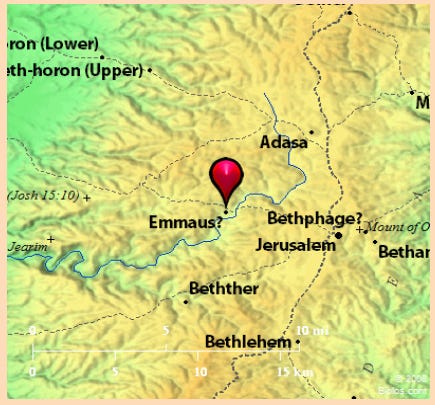
From the map, you can see that a stream or river runs by the village. This water was used by the villagers for bathing to clean themselves after a day of hard work shepherding their sheep in this hilly region. Today, we can come to Jesus and have our sins washed away because Jesus died for us. Today, we can come to the risen Jesus and repent for our sins.
In the Book of Revelation, we see the remnant of Israel turning to Jesus. John wrote, “These are they who have come out of the great tribulation; they have washed their robes and made them white in the blood of the Lamb.” They came to Jesus and had their sins washed away. Today, as we read the Book of Isaiah, the prophet encourages us: “Come now, let us settle the matter,” says the Lord. “Though your sins are like scarlet, they shall be as white as snow; though they are red as crimson, they shall be like wool.”
The Easter story is a story of repentance and the washing of our sins, because Jesus took our sins on the cross, so that we would be seen by God as sinless. The holy God who sent Jesus Christ, the Son of God, to earth is a holy God. When Jesus was on the cross, we note that, “From noon until three in the afternoon darkness came over all the land. About three in the afternoon Jesus cried out in a loud voice, “Eli, Eli, lema sabachthani?” (which means “My God, my God, why have you forsaken me?”).” The Holy God had abandoned Jesus because the sins of all mankind rested upon Him, and God could not bear to look at His precious Son, whom He loved.
Today, this Easter Sunday, serves as a call to repentance, inviting us to ask Jesus to wash away our sins so we can cultivate a close relationship with the living God through Jesus Christ, who rose from the dead.
The two disciples said that Jesus was “...a prophet, powerful in word and deed before God and all the people.” Of course, Jesus was much more than a prophet; He was the Son of God. However, they were correct; he spoke the words that God wanted Him to speak. Jesus himself said, “The words I say to you I do not speak on my own authority. Rather, it is the Father, living in me, who is doing his work.”
So, yes, he was a prophet. Additionally, the two disciples noted that his words were powerful. There are many examples in which Jesus spoke a word, and something happened. When he was at Capernaum, a man was demon-possessed. Jesus was in the local synagogue and said, “Come out of him!” Then the demon threw the man down before them all and came out without injuring him.” At another time, Jesus healed a man just by speaking. Jesus told the man, “Your faith has made you well,” and the man immediately received his sight. Later, Jesus brought a young man back to life just by speaking. The young man at Nain was already in a coffin, but Jesus simply said, “Arise,” and the man arose. Yes, Jesus’ words were powerful.
Jesus’ deeds were powerful. When John was in prison and experienced a moment of doubt, he sent some of his disciples to Jesus and asked if he was the one to come or if they should be waiting for someone else. Jesus responded by saying, “to the messengers, “Go back and report to John what you have seen and heard: The blind receive sight, the lame walk, those who have leprosy are cleansed, the deaf hear, the dead are raised, and the good news is proclaimed to the poor.” Yes, Jesus’ deeds were powerful.
Just before Jesus ascended to heaven to be with Father God, he told his disciples, “But you will receive power when the Holy Spirit comes on you; and you will be my witnesses in Jerusalem, and in all Judea and Samaria, and to the ends of the earth.” After Jesus had ascended, it was the Apostles who were going to speak, and they would speak with power. This is clearly illustrated when Peter and John went to pray at the temple. They encountered a beggar who asked for money. Peter responded to the beggar by saying, “Silver or gold I do not have, but what I do have I give you. In the name of Jesus Christ of Nazareth, walk.” Taking him by the right hand, Peter helped him up, and instantly the man’s feet and ankles became strong. The Apostles’ words were powerful.
Today, we believe that Jesus is Jehovah Rophe, the Lord who heals. Jesus Christ ascended into heaven to be with Father God so that the Holy Spirit could come down. The same Holy Spirit who formed the universe and everything in it and healed the beggar now resides within us. Therefore, today, we have the same ability to speak powerful words and perform mighty deeds. The question is this: Do you believe this? Do you believe you can say a word of faith and that God can act? Do you believe that your faith, though as small as a mustard seed, can bring life to another? Or are you willing to let your friends, neighbours, and family remain in poor health? Do you believe your words and deeds can be powerful?
He Has Risen! Hallelujah! Happy Easter, my friend!
HE IS RISEN! Blessing to you, and your family, Robert!